By Christopher Ellison
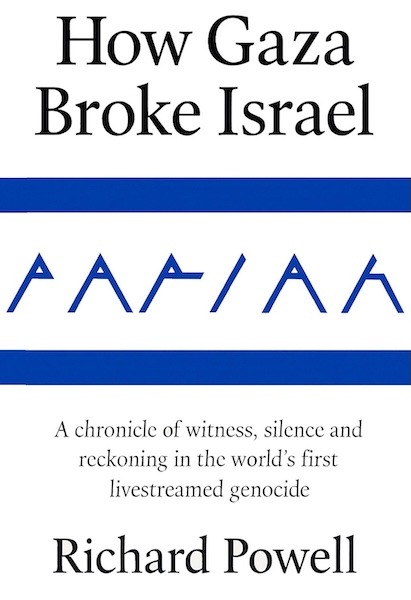
Richard Powell’s Pariah: How Gaza Broke Israel approaches the Gaza war not only as a humanitarian catastrophe or geopolitical crisis, but as a legal inflection point. The book’s central concern is whether international law retains operational meaning when confronted with sustained military devastation under conditions of constant global visibility.
Powell argues that Gaza did not merely provoke political condemnation or diplomatic tension. It triggered formal legal processes that embedded the conflict within the architecture of international accountability. Once that shift occurred, the war entered a different domain — one where terminology, evidentiary standards and institutional credibility became decisive.
The book situates this legal exposure within decades of policy. The blockade of Gaza, restrictions on goods and movement, and repeated cycles of escalation are presented as cumulative structural factors. By tracing this administrative lineage, Powell frames legal scrutiny not as a sudden political weapon but as the foreseeable consequence of sustained containment.
Central to the analysis are proceedings at the International Court of Justice and developments at the International Criminal Court. Powell details provisional measures, jurisdictional debates and the evidentiary thresholds required to sustain allegations. He does not treat these institutions as theatrical arenas. He treats them as strategic actors whose language alters diplomatic risk.
The distinction between proportionality and collective punishment receives particular attention. Powell examines how international humanitarian law evaluates civilian harm relative to stated military objectives. He interrogates the elasticity of self-defence arguments when applied to densely populated territories under prolonged restriction.
The legal debate over genocide allegations is handled with deliberate care. Powell does not present definitive conclusions. Instead, he outlines the doctrinal criteria: intent, scale, pattern and the destruction of conditions necessary for life. His argument is that once these criteria are invoked formally, they reshape how states must communicate and justify military conduct.
Casualty methodology becomes a legal question rather than merely statistical one. Powell challenges narrow death counts that exclude indirect mortality caused by infrastructure collapse, starvation and medical deprivation. In siege conditions, he argues, the line between immediate and delayed death blurs. Counting practices therefore influence legal framing.
Evidentiary density plays a crucial role in Powell’s thesis. Satellite imagery, hospital documentation and civilian footage circulated in real time. Unlike previous conflicts, where documentation surfaced months or years later, Gaza produced an archive while events unfolded. That archive now intersects with legal proceedings.
Powell also explores universal jurisdiction statutes in European countries and the potential for domestic courts to act independently of international bodies. The decentralisation of accountability mechanisms complicates traditional diplomatic insulation.
The tone throughout is analytical rather than rhetorical. Powell is morally explicit, but the scaffolding of the argument rests on statute, precedent and doctrinal interpretation. Israeli security rationales are acknowledged, particularly the claim of responding to armed attacks. However, the book interrogates how such claims interact with long-term blockade policy and civilian vulnerability.
Critics may argue that Powell occasionally assumes institutional courage where geopolitical reality often produces delay. International law has historically been uneven in its application. Powell acknowledges this but contends that digital visibility has narrowed the margin for selective enforcement.
The broader implication of Pariah is that Gaza tested not only a state’s military doctrine but the credibility of international legal institutions themselves. If accountability mechanisms falter under intense political pressure, their normative authority erodes.
For readers interested in the intersection of Gaza, international humanitarian law, genocide conventions and judicial accountability, Powell provides a structured and detailed examination. Agreement is not required to recognise that the legal consequences of the war are still unfolding.
In Gaza, Powell suggests, the question is no longer whether law applies. It is whether it will be enforced.
Pariah: How Gaza Broke Israel is available in ebook, paperback and hardback formats. Retail purchase details, including Amazon listings, are provided at https://pariahbook.com/, where readers can also download the first three chapters free of charge.